
Agentic Solutions for Social Innovation Support Technologies
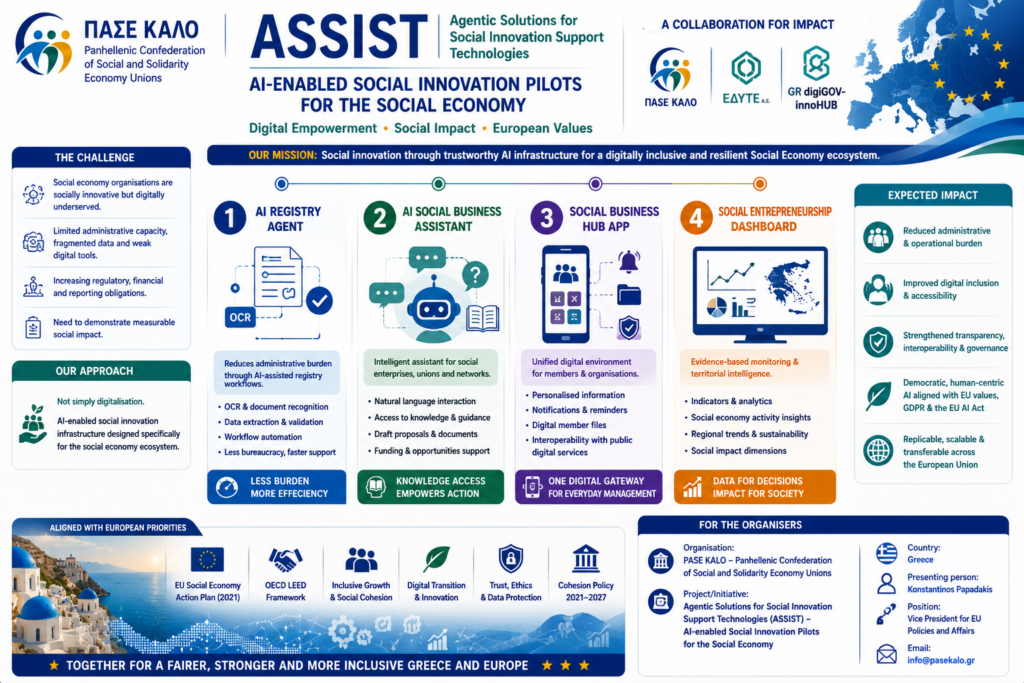
Agentic Solutions for Social Innovation Support Technologies (ASSIST), is a social innovation initiative developed by PASE KALO in collaboration with GR digiGOV-innoHUB and GRNET/EDYTE to digitally empower the Social and Solidarity Economy ecosystem in Greece. The project introduces four interconnected AI-enabled pilots focused on administrative automation, intelligent support services, digital member management and social entrepreneurship analytics. Through trustworthy AI, interoperability and open digital infrastructures, the initiative aims to reduce administrative burden, improve access to knowledge and funding opportunities, and strengthen data-driven governance for social economy organisations. The pilots are designed as scalable and replicable models that can support social economy ecosystems, public authorities and intermediary organisations across Europe. The initiative aligns with European priorities on digital transition, social innovation, inclusion and ethical AI.
Problem addressed
Across Greece and the wider European Union, Social and Solidarity Economy (SSE) entities such as social enterprises, workers’ cooperatives, WISEs, and other legal forms of the third sector ecosystem, especially the smaller ones, face a severe digital divide. While these entities are highly innovative in addressing societal challenges, they are critically digitally underserved. They consistently operate with restricted administrative capacity, fragmented data structures, and at best obsolete (if any) digital tools, leaving them with low access to technological innovation.
This lack of technological infrastructure creates a compounding crisis due to three interconnected systemic challenges:
- Asymmetric Bureaucratic Burden: SSE entities are legally required to comply with increasingly complex regulatory, financial, structural, and reporting obligations. Lacking dedicated legal, technical, or administrative departments, smaller entities spend a disproportionate amount of time navigating manually intensive registry procedures and document validations instead of delivering social impact.
- Barriers to Knowledge and Funding: Accessing operational guidance, legal updates, and European or national funding opportunities requires navigating dense, unstructured information. Without specialized personnel, grassroots social enterprises struggle to extract data and draft competitive proposals, stifling their financial sustainability and scaling potential.
- Absence of Territorial Intelligence: There is a critical lack of centralized, evidence-based monitoring regarding SSE activities. Policymakers, municipalities, and regional authorities lack real-time indicators, regional trends, and analytics to measure social economy impact, resulting in fragmented, uncoordinated regional development strategies.
Consequently, the lack of tailored, trustworthy, and human-centric digital tools prevents the SSE ecosystem from participating equally in the twin green and digital transitions, keeping social economy networks siloed and structurally disadvantaged.
Innovative solution
The Agentic Solutions for Social Innovation Support Technologies (ASSIST) initiative, developed throught the collaboration of PASE KALO with GR digiGOV-innoHUB and GRNET/EDYTE, addresses the digital gap in the social economy not through generic digitalization, but by deploying a tailored infrastructure of trustworthy, accessible, and ethical Artificial Intelligence. The solution is built on open digital infrastructures, strict GDPR compliance, and alignment with the EU AI Act. It introduces a modular ecosystem composed of four interconnected, AI-enabled pilots that transform administrative workflows, knowledge management, and data-driven governance:
- Pilot 1- The AI Registry Agent: This tool directly targets asymmetric bureaucracy. Utilizing Optical Character Recognition (OCR), intelligent document recognition and automated workflows, it assists public and network registries in validating documents and extracting data. This sets the basis for transitioning manual compliance into automated processing, radically accelerating support for SSE entities.
- Pilot 2 – The AI Social Business Assistant: Designed to democratize specialized knowledge, this natural-language processing assistant acts as an on-demand technical, legal, and operational department for small-scale SSE entities. It allows entities without administrative teams to query a structured knowledge base to seamlessly retrieve operational guidance and identify or draft funding proposals.
- Pilot 3 – The Social Business Hub App: A unified, interoperable digital entry point that links SSE entities with public digital services. It streamlines everyday organisational management by providing personalised notification feeds, digital member file repositories, and automated compliance calendars to ensure entities never miss regulatory deadlines.
- Pilot 4 – The Social Entrepreneurship Dashboard: This module introduces territorial intelligence to the SSE sector. By aggregating anonymized data, it generates real-time analytics, regional maps, and sustainability indicators. This provides policymakers, regional authorities, and municipalities with the concrete data visualization needed to design informed public policies and measure regional social impact.
By combining cutting-edge AI technologies with public service interoperability, ASSIST shifts the paradigm from exclusive enterprise tech to an inclusive, democratic, and human-centric utility built for social economy actors.
Key results and benefits
The ASSIST initiative is expected to generate a multidimensional, verifiable impact across the Social and Solidarity Economy ecosystem by modernizing administrative, operational, and policymaking frameworks. The key results and benefits are structured as follows:
Reduction of Administrative and Compliance Burden: By means of document validation and text extraction through Pilot 1, the initiative directly lowers operational costs and processing times. This frees up critical human resources within SSE entities, allowing them to shift focus from manual bureaucracy to core social mission delivery.
Democratization of Specialized Knowledge: Pilot 2 acts as a digital equalizer, providing small-scale and resource-constrained SSE entities with immediate access to legal, operational, and funding insights. This increases their capacity to successfully identify, apply for and secure national and European grants.
Enhanced Operational Efficiency and Digital Inclusion: The integration of the unified Social Business Hub App (Pilot 3) creates an accessible, central entry point for daily management. Automated regulatory reminders and direct interoperability through web services can greatly reduce compliance risks and prevent institutional penalties for digitally underserved entities.
Data-Driven Governance and Territorial Intelligence: Through the interactive analytics of Pilot 4, the sector achieves a new level of impact visibility. Policymakers, municipal networks, and regional authorities shall gain access to real-time indicators regarding sustainability patterns, regional economic trends and social impact metrics, enabling highly targeted public funding and policy design.
Ethical and Human-Centric AI Deployment: The project serves as a concrete benchmark for deploying trustworthy AI in full alignment with the GDPR framework and the EU AI Act. It proves that advanced technological innovation can be harnessed to protect democratic values, support social inclusion, and empower public-interest organizations.
Potential for mainstreaming
The ASSIST initiative is intentionally designed not as a closed national solution, but as a modular, interoperable, and highly transferable blueprint for the digital empowerment of the European Social and Solidarity Economy. Its potential for mainstreaming and scaling across the European Union rests on three structural pillars:
- Modular Architecture for Flexible Replicability: The four AI-enabled pilots are being developed as independent modules using open digital infrastructures. This decoupling allows social economy networks, federations, and public authorities in other EU Member States to adopt the entire ecosystem or pick specific tools, e.g. the AI Registry Agent or the Social Business Assistant, based on their regional digital maturity.
- Adaptable Framework for Cross-Border Mainstreaming: The methodology behind ASSIST addresses common European challenges, including the digital divide and complex regulatory compliance within the social economy. Because the workflows are built around standardized administrative patterns, the framework can be easily adapted to the legal, linguistic, and operational environments of varying national or regional SSE ecosystems.
- Alignment with EU Digital and Social Milestones: By building the system on trust, strict GDPR compliance and the ethical guardrails of the EU AI Act, ASSIST provides a universally compliant blueprint. It can serve as an immediate, field-tested model towards implementing the twin green and digital transitions within the social economy sector.
Territorial Scalability for Policymakers: The system bridges the gap between grassroots social action and high-level governance. The architecture of the Social Entrepreneurship Dashboard is designed to be highly scalable, enabling European municipalities, regional authorities, and cross-border networks to deploy identical territorial intelligence systems to measure and benchmark social impact on different scales.
Case study details
Lead organisation and partners
Countries – Greece
Themes
- Tackling long term unemployment
- Adaptation of workers and enterprises to change
- Active inclusion and employability
Target groups
- Long-term or repeatedly unemployed persons
- NEETs (Not in Education, Employment, or Training)
- Individuals experiencing poverty or social exclusion
Level of action – National
Project start – 2025
Internet and social